Aranet4 Home CO2 Monitor
The reference consumer CO2 monitor: a battery-powered e-ink puck with a true NDIR sensor that shows at a glance how badly a room needs ventilating.
Strengths
- Genuine NDIR sensor with class-leading rated accuracy for a consumer device
- Always-visible e-ink display with simple green/amber/red guidance - no app needed day to day
- Runs for months to years on two AA batteries; rechargeables work
Watch outs
- Premium price - notably more than newer rivals with comparable rated accuracy
- Hardware has barely changed since release; no Wi-Fi, only short-range Bluetooth
- Not waterproof and somewhat fragile - the e-ink screen wants a case in a bag
- CO2 sensor True NDIR (Senseair Sunrise), 0-9999 ppm, accuracy +/-(30 ppm + 3% of reading)
- Other sensors Temperature (0-50 C, +/-0.3 C), relative humidity, atmospheric pressure
- Display Always-on e-ink with colour-coded CO2 status and optional buzzer (default red threshold 1400 ppm)
- Power 2 x AA batteries; battery life from many months up to ~4 years depending on measurement interval and battery type
We may earn a commission if you buy through this link - it never changes the price you pay or our editorial verdict.
As an Amazon Associate I earn from qualifying purchases.
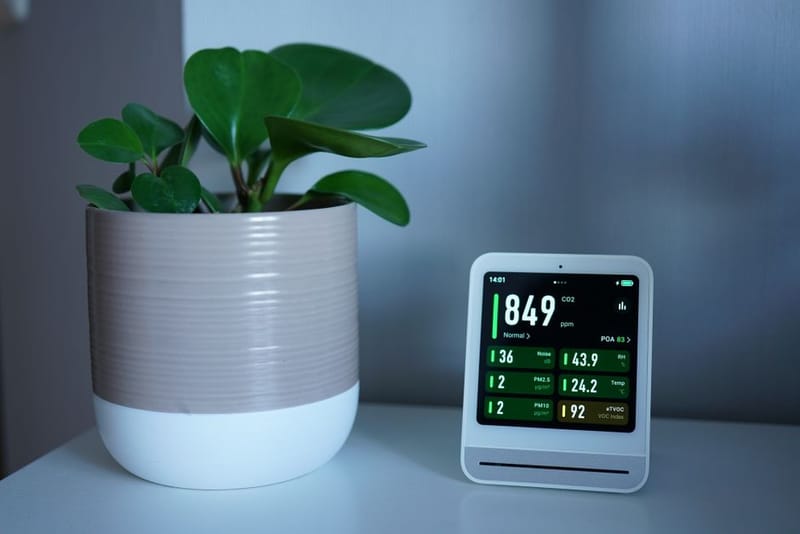
What does a CO2 monitor actually tell you?
Carbon dioxide (the gas people exhale, measured here in parts per million) is a proxy. It is not itself the problem at indoor levels; it is the easiest signal that the air in a room is being breathed and not replaced. Fresh outdoor air sits around 400 to 420 ppm, so the gap between that and what a room reads is a measure of how much of the air around you has already been through someone's lungs.
HSE guidance on using CO2 monitors states that "CO2 levels consistently higher than 1500ppm in an occupied room indicate poor ventilation and you should take action to improve it", and is careful to add that "CO2 measurements are only a broad guide to ventilation rather than demonstrating 'safe levels'". That is the right way to read the number on the screen: a prompt to open a window, not a verdict on the air.
Why does the NDIR sensor matter?
This is the single specification that separates CO2 monitors, and it is why the Aranet4 costs what it does. It uses a true NDIR sensor, which measures carbon dioxide directly by how much infrared light the gas absorbs. HSE's guidance is explicit that "the most appropriate portable devices to use in the workplace are non-dispersive infrared (NDIR) CO2 monitors".
The alternative found in cheaper units is an eCO2 or equivalent-CO2 reading. Those sensors do not detect carbon dioxide at all. They measure volatile organic compounds and estimate a CO2 figure from them, which means a reading can spike from cooking, cleaning spray or aftershave while the ventilation has not changed, and can sit flat in a stuffy sealed room. Aranet rates the Aranet4 at plus or minus 30 ppm plus 3 per cent of the reading, which is a specification an estimating sensor cannot meaningfully offer.
Why does it suit renters?
Rented flats are frequently the hardest cases: small rooms, sealed modern glazing, trickle vents painted shut or taped over by a previous tenant, and no control over the ventilation system. A monitor needs no wiring, no drilling and no fixing to anything, so nothing about it depends on the landlord's agreement, and it moves to the next flat in a coat pocket at the end of a tenancy.
The reading is also useful before you sign anything. Taken to a viewing, a monitor gives a quick read on a room that has been shut up, which is exactly the situation the flat will be in on a winter evening. And because stale air and condensation are the same underlying problem, the number tends to lead straight to the measures in our guide to stopping damp and condensation in a rented flat. For the thresholds themselves, see CO2 monitors for a home office, explained.
How long do the batteries last?
It runs on two AA cells rather than a charging cable, and Aranet quotes anything from many months up to around four years depending on how often it is set to measure and which batteries are used. Rechargeable AAs work. The practical consequence is that it can sit on a shelf as a permanent instrument rather than another device competing for a USB socket, which matters in a flat where sockets are already the scarce resource.
The always-on e-ink display is part of the same design logic. Because e-ink draws power only when the reading changes, the current figure and its colour-coded status stay visible without waking anything, so day-to-day use involves no app at all. Bluetooth and the free Aranet Home app are there when you want history, trends or a custom alert threshold, not as the route to a basic reading.
What are its limits?
It measures CO2, temperature, humidity and pressure, and nothing else. There is no PM2.5 sensor and no VOC sensor, so it says nothing about cooking particulates, wood smoke or traffic-borne pollution. If the question is "is the air dirty", this is the wrong instrument; if the question is "is this room ventilated", it is the right one.
The other limits are commercial rather than technical. It carries a premium over newer rivals quoting comparable accuracy, the hardware has changed little since release, and connectivity is short-range Bluetooth with no Wi-Fi, so there is no remote checking from outside the flat. It is also not waterproof and the e-ink screen is worth protecting in a bag. Against that, reviewers who have owned units for several years report them still reading accurately, which is the argument for the price.
What is a high CO2 reading in a room?
Is the Aranet4 better than a cheap CO2 monitor?
Does the Aranet4 need Wi-Fi or an app?
Can a CO2 monitor help with damp and condensation?
Does it measure air pollution such as PM2.5?
- CO2 sensor
- True NDIR (Senseair Sunrise), 0-9999 ppm, accuracy +/-(30 ppm + 3% of reading)
- Other sensors
- Temperature (0-50 C, +/-0.3 C), relative humidity, atmospheric pressure
- Display
- Always-on e-ink with colour-coded CO2 status and optional buzzer (default red threshold 1400 ppm)
- Power
- 2 x AA batteries; battery life from many months up to ~4 years depending on measurement interval and battery type
- Connectivity
- Bluetooth to the free Aranet Home app (trends, history, alert thresholds)
- Dimensions
- 70 x 70 x 24 mm, 104 g
- Calibration
- Factory-calibrated; automatic background or manual recalibration supported
- Warranty
- 2 years (extendable to 3)
- Subscription
- None