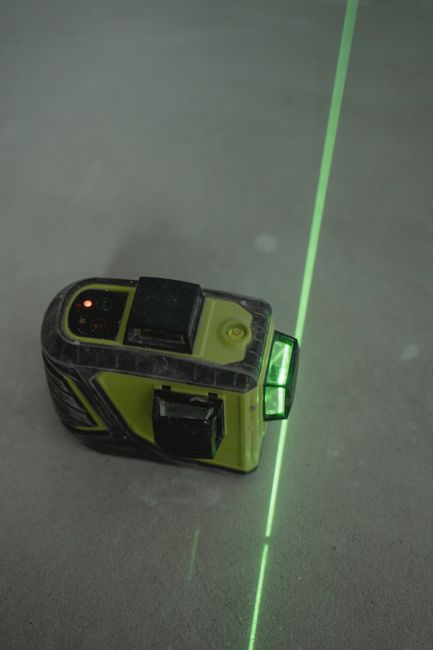
Huepar BOX-1G Cross Line Laser Level
A budget green-beam self-levelling cross line laser - the straight-line cheat code for hanging pictures, shelves and curtain poles right first time.
Strengths
- Bright, thin green lines - reviewers measure about 2 mm at 1 m and report them still sharp at 10 m
- Self-levels in a couple of seconds, so a level line is instant and trustworthy
- Rugged for the money: IP54, rubber armour, sealed battery bay and quality internals noted by reviewers
Watch outs
- Power behaviour is fiddly - the toggle stays live and a full shutdown needs a 3-second hold
- Tilt warning is visual only, with no audible alert
- About 4 hours per set of batteries with all beams on - rechargeables recommended
- Laser Green, 510 +/-5 nm, Class 2 (<1 mW), Osram emitters
- Accuracy +/-2 mm at 10 m (quoted as 1/13 in at 33 ft)
- Fan angles 130 degrees horizontal, 150 degrees vertical
- Modes Horizontal, vertical, or cross line; pulse mode for use with a receiver (to ~50 m)
We may earn a commission if you buy through this link - it never changes the price you pay or our editorial verdict.
As an Amazon Associate I earn from qualifying purchases.
What is a cross line laser for in a rented flat?
Getting things straight the first time, which in a rental is worth more than it sounds. Every hole you drill is one you may have to make good at the end of the tenancy, so a picture rail hung a degree out and re-drilled twice is not just annoying, it is a deposit question.
The jobs it earns its keep on are the repetitive ones: a row of picture frames at a consistent height, a shelf that has to be level across two brackets, a curtain pole square to the window rather than to the ceiling, or tiles and splashbacks. A spirit level does all of this too, but it only tells you about the span it covers, and it needs a hand. A projected line stays put across the whole wall while both your hands are busy. For the wider set of jobs, our guide to building and dismantling flat-pack in a rented flat covers the other tools worth owning.
Why green rather than red?
Visibility. The BOX-1G uses green emitters at 510 nm, and the human eye is substantially more sensitive to green than to red at equivalent power. The practical result is a line you can still see across a bright room, where a red line at the same Class 2 output can wash out and force you to draw the curtains.
The trade-offs are real but minor at this level. Green diodes draw more power, which is part of why runtime is around four hours with all beams on, and green units generally cost a little more than the red equivalent. Against that, a laser you cannot see in daylight is a laser you stop using. For indoor DIY in normal domestic lighting, green is the sensible default.
How accurate is the quoted figure in practice?
Huepar quotes +/-2 mm at 10 m, which is the specification to plan around. It is worth translating: across a typical three-metre living room wall that is well under a millimetre of potential error, which is far finer than the tolerance of the fixings, the wall itself or your pencil mark. For hanging pictures, shelves and poles it is not the limiting factor.
Two things matter more than the headline number. The first is that self-levelling only operates within a 4-degree range, so the unit must start roughly level or it cannot compensate at all. The second is that the tilt warning is visual only, with no audible alert - so if you are not looking at the tool when it goes out of range, you can work to a line it is no longer guaranteeing. Glance at it when you reposition.
How do you use it without drilling anything?
This is the part that makes it renter-friendly, and it is a genuine design feature rather than a workaround. The included L-bracket rotates through 180 degrees and is magnetic, so it will hold to any steel surface - a radiator, a metal door frame, a shelf bracket already in place. The same bracket takes a 1/4 in-20 thread, which is the standard camera tripod fitting.
In practice that means a cheap photo tripod becomes your laser stand, positioned anywhere in the room and adjusted to the height you need, with nothing attached to the wall at all. For lower work, standing the unit on a stack of books on a table is entirely legitimate - self-levelling handles the rest, provided you are within that 4-degree window. The pendulum also locks, which protects the mechanism in a drawer or bag and lets you project a deliberate angled line when you want one.
What are the real annoyances?
Three, and none is a dealbreaker, but all are worth knowing before you buy. The power behaviour is fiddly: the toggle stays live and a genuine shutdown needs a three-second hold, which is easy to get wrong and leaves the unit draining batteries in a bag. The tilt warning being visual-only is the second, as above.
The third is runtime. Four AA batteries give about four hours with all beams on, which is fine for an afternoon of hanging things and poor value if you use it regularly - rechargeable AAs are the obvious answer and the reason the AA format is arguably a feature rather than a limitation. Finally, note the fan angles: 130 and 150 degrees give you lines across a wall, not the wraparound 360-degree coverage of a more expensive unit. For domestic jobs that is almost always enough.
Is +/-2 mm at 10 m accurate enough for hanging shelves?
Why choose a green laser over a red one?
Can I use it in a rented flat without drilling?
How long do the batteries last?
Does it level itself automatically?
- Laser
- Green, 510 +/-5 nm, Class 2 (<1 mW), Osram emitters
- Accuracy
- +/-2 mm at 10 m (quoted as 1/13 in at 33 ft)
- Fan angles
- 130 degrees horizontal, 150 degrees vertical
- Modes
- Horizontal, vertical, or cross line; pulse mode for use with a receiver (to ~50 m)
- Self-levelling
- Pendulum compensator, 4 +/-1 degree range, settles in under ~2-3 seconds; lockable for manual angles and transport
- Protection
- IP54 - dust, splash and shock resistant, rubber-armoured housing
- Power
- 4 x AA batteries, about 4 hours with all beams on
- Mounting
- 1/4 in-20 tripod thread plus included 180-degree-rotating magnetic L-bracket
- Operating temperature
- -10 C to +50 C
- Subscription
- None